
These Catholics are all members of Opus Dei, a prelature of the Catholic Church. In Latin, Opus Dei means "God's Work." Members of "the Work" believe that holiness is something to be strived for in one's daily life: in one's job, however important or however humble; in one's friendships; and in one's family life and civic obligations.
Opus Dei does good works all over the planet, punching far above its demographic weight. Few in number--about 85,000 worldwide and only a few thousand in all of Canada -- they are immersed in public life in the most positive and benign ways. And of the more than 100,000 members of the Conservative party, why yes, a handful probably are also members of Opus Dei.
But the back story to Mr. Duceppe's naming (and by implication shaming) of these three people is not his apparently high-minded upholding of the division of church and state. It is his loathing for the Catholic Church, a loathing he is at small pains to conceal. In this he is representative of the media and political elites that dominate Quebec's public discourse. And that is the real story here.
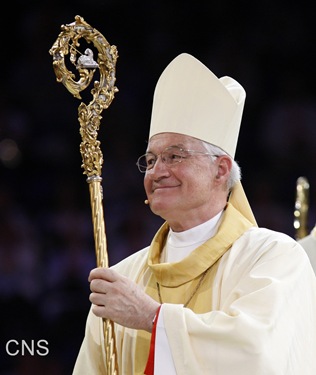 Look at the reaction to Cardinal Marc Ouellet's call for public debate on the morality of abortion. He did not call for legislative change. He called abortion a "moral crime." In response the francophone media went ballistic. It is unthinkable that any Canadian pundit would say of an imam, as La Presse's Patrick Lagace did of Cardinal Ouellet : "We must all die. We are all going to die. Cardinal Ouellet is going to die one day. I hope he will die of a long and painful sickness...Yes, the paragraph I have just written is vicious. But [Cardinal] Marc Ouellet is an extremist. And in this debate, all blows are permitted against religious extremists... the Cardinal is a fundamentalist. This is a known fact. From there on, whoever agrees to share a political podium with him should be treated like an accomplice to the fanaticism of Kazem Ouellet."
Similarly, would any Canadian journalist call for the dissolution of Islam because parts of shariah law run counter to Canadian gender values? Yet on May 28 Le Devoir published an op-ed calling for the dissolution of the Church and its transformation in Quebec into a network of cooperatives: "This co-operative network, based on modern values of equality and non-segregation of the sexes, of anti-racism and the rejection of homophobia, would permit us to experience together, socially and ceremoniously, the great moments of life between birth and death. This project of modernization of the Catholic institution seems to me, moreover, completely compatible with the fundamental secularity of the state which is indispensable to social peace."
Christian Rioux of Le Devoir, one of the very few journalists in the French media to offer a balanced and fair perspective, responded to his colleagues' venom on May 28: "The virulent anti-clericalism expressed in the last two weeks would be unimaginable in most European countries, where a speech like that of Msgr. Ouellet would have been received with calm and due measure, if not indifference. With all the more reason since [Cardinal Ouellet] himself admits that 'the ultimate responsibility for the moral decision [of abortion] arises from personal conscience.'"
The old adage "familiarity breeds contempt" was never so fulsomely displayed in this country as it has been by Quebec's elites in the last few weeks. Shame on them. Gilles Duceppe owes a public apology to the people whose good name he has tarnished and to the prelature of Opus Dei. Others should do a little soul-searching as well. If anti-clerical public figures want to retain their credibility with ordinary citizens, they would do well to curb their personal animosity toward an institution that, in stating its Charter-protected beliefs, expresses no animosity to them.


